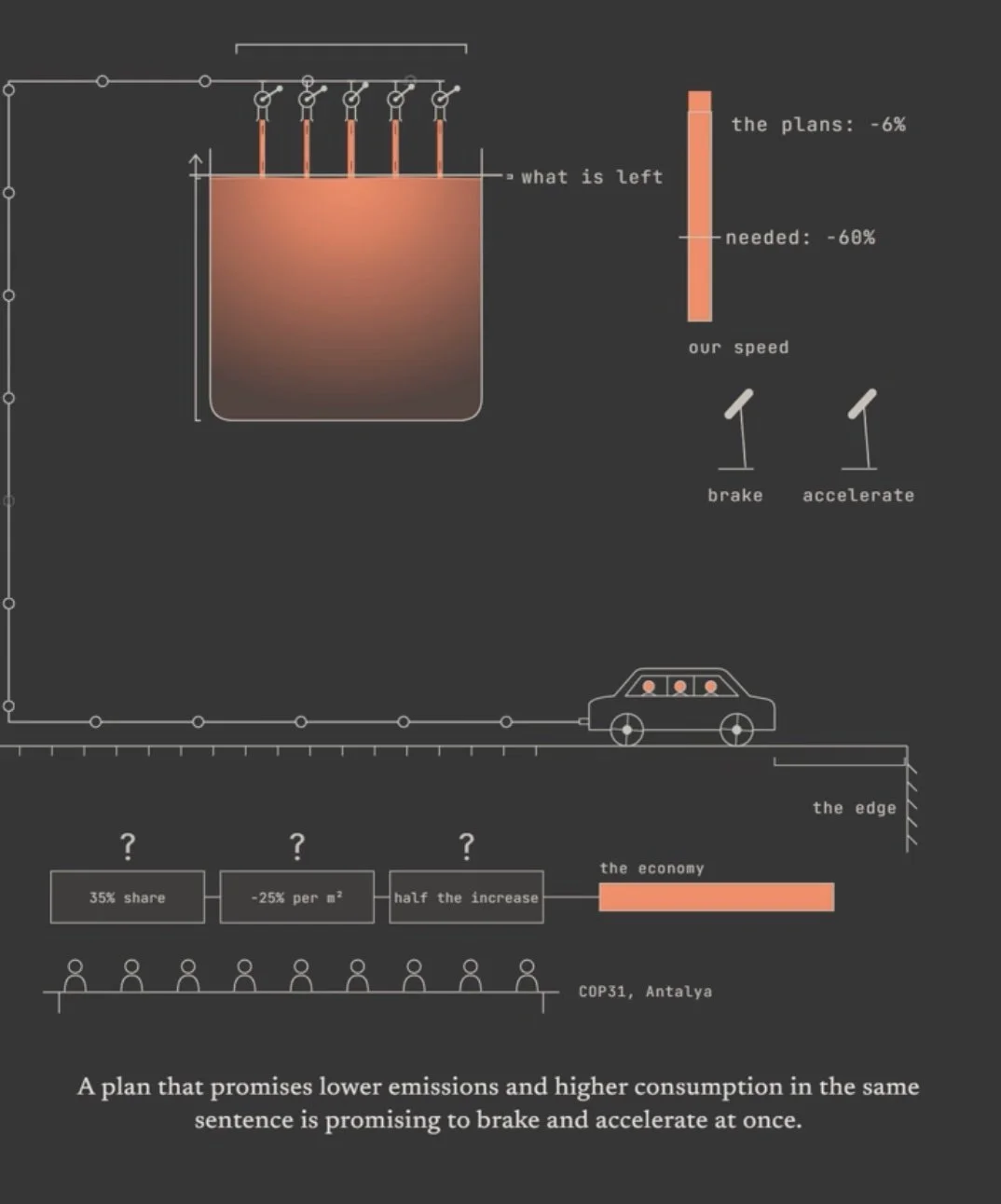
This is one of the most helpful explanations of the conundrum of consumption, carbon emissions, and our political and economic choices. This explanation is made even more helpful by being a visual, with commentary about what is happening rather than a written note to try to to convince us of the reality of the situation we are currently facing. As I sit reflecting on this, I wonder what I can do, what I can do with my community, and why so many governments are in cognitive dissonance about expanding the way we consume things that contribute carbon, exacerbating a crisis caused by overconsumption in the first place.
"We believe the fix is to consume differently, when the problem is how much we consume. Relative targets are what that belief looks like on paper.
It shows why a record year for renewables did not bring emissions down, why the promise of removing CO2 later keeps us consuming now, and what a plan looks like when it is measured against the atmosphere: avoid first, then reduce, then restore. It is not an argument against renewables. It is an argument against the idea that we can solve overconsumption by consuming more."
“Three moves are necessary:
1. Avoid. This is sufficiency.
It means movingg from never enough, to enough for all. Every trip we don't make, every square metre we don't build, everything we don't buy, puts nothin in the tank. This is the biggest lever, and the one that no one plans starts with.
2. Reduce. This is efficiency.
We use only what we already have and we use it better. Efficiency belongs here, inside a total that shrinks every year, not instead of one that keeps growing.
3. Restore. This is about regeneration and restoration, making things better.
The tank has one real drain, and it is the living world. Forests, wetlands, soils, and oceans take CO2 out, slowly, and only if we let them grow.
Our pressure on the environment at the present time (with 8.3 billion people) exceeds our biocapacity, nature's capacity to absorb this environmental pressure, through the things we are doing, mining, and making. Today, this pressure is far above bio-capacity. We can avoid and reduce, bringing pressure down. Restoring lifts bio-capacity.
Only at the point where environmental pressure falls below bio-capacity can we collectively start to back away from the edge.”
Please watch this video (see link, and share with others in your network. We don't need to judge others. We need to help create clarity around what is happening, so that we can all be contributors to real actions that help us all.
An 8 minute explainer film.
It shows why, despite all the pledges, we keep making it worse.